The Pugilist
DEUCE
by Paul Newman
|16.11.2011
With an aggressive game that wouldn’t be out of place in the boxing ring, Muhammad Ali lookalike Jo-Wilfried Tsonga often blasts opponents off the court.
Like any self-respecting Frenchman, Jo-Wilfried Tsonga appreciates good food. When leading ATP players joined a celebrity chef evening during the US Open one year, it was no surprise to find the French No. 1 among them. Tsonga prepared a pasta dish which was subsequently served to hundreds of paying guests. But his cuisine specialities, he says, are desserts, “especially tiramisu”.
If the kitchen is not the first place you’d expect to find a strapping young sportsman, who bears a remarkable resemblance to a youthful Muhammad Ali, there are other surprises in store when you meet 26-year-old Tsonga. He is softly spoken, with an engaging smile, and his idea of a perfect day off is to go fishing on the banks of a quiet river. “I like peace and tranquillity, being outside in the fresh air,” says this man who was brought up near Le Mans, in northern France, and now lives in Switzerland.
“He loves to attack the net and overwhelm opponents with his raw power”
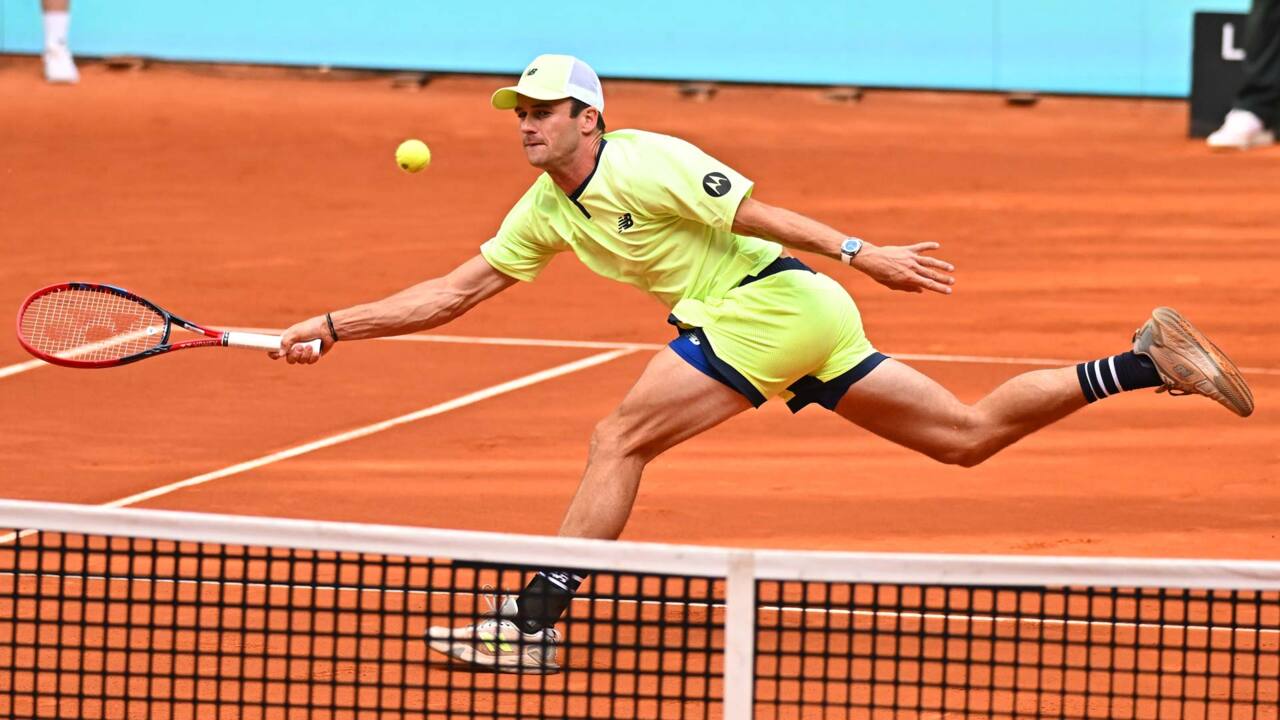
Peace and tranquillity, however, are rare when Tsonga is on court. An aggressive player with a big serve and booming groundstrokes, he loves to attack the net and overwhelm opponents with his raw power. He is a nimble mover for such a big man, standing at 6ft 2ins and weighing more than 200 pounds, and you sense that one of the main reasons he loves playing on grass is the opportunity to hurl himself around the court, Boris Becker-style. “This is the only surface where you can really dive because, on the others, if you dive you go directly to the hospital,” he said with a smile at Wimbledon this summer.
It was at the All England Club in June that Tsonga enjoyed one of his finest moments, when he beat Roger Federer in the quarter-finals. “It’s just amazing,” he said afterwards. “The feeling is like maybe I beat Nadal in Roland Garros. For me it will be, for sure, one of the best memories in my career.”
It was the first time in 178 Grand Slam matches that Federer had surrendered a two-set lead. For Tsonga, it launched a superb run through the second half of the season – including reaching the quarter-finals at the US Open, winning titles in Metz and Vienna, and finishing runner-up in Paris – all of which earned him the South African Airways ATP Ranking points he needed to qualify for London.
The only other occasion when Tsonga has qualified for the end-of-season finale was in his breakthrough year in 2008, which started with his extraordinary performances at the Australian Open. Having surprised Andy Murray in the first round, the then World No. 38 counted Richard Gasquet, Mikhail Youzhny and Rafael Nadal among his victims en route to the final before losing to Novak Djokovic. Remarkably, it was his first appearance in any final on the main tour.
Tsonga had first been noted by the British public in 2007, when Lleyton Hewitt was among five of his victims at Queen’s Club. On the Saturday before the tournament he won two qualifying matches in the morning before dashing across London to win a semi-final in the Surbiton Challenger tournament in the afternoon. His only other appearance at Queen’s was this year when he beat Nadal in the quarter-finals and eventually lost to Murray in the final.
Although his talent had long been recognised – he was the junior World No. 2 and won the US Open boys’ title in 2003, one year before Murray’s victory in New York – Tsonga was a late developer as a senior, his career having stalled after serious injuries to his back, shoulders and knees.
“I think I have the same tennis as his boxing”
Tsonga’s father, Didier, introduced him to tennis when he was only four years old. Born in Congo, Didier came to France in the late 1970s to study for a chemistry degree in Le Mans, where he met his future wife, Evelyne. They are quite a sporting family. Didier was a handball international, while Enzo, Jo-Wilfried’s younger brother, is a basketball player. Charles N’Zogbia, the Aston Villa footballer, is a second cousin.
Remarkably, Jo-Wilfried’s resemblance to Ali is not the only family connection with the legendary boxer. Before emigrating to France, father Didier lived in Brazzaville, which sits on the other side of the Congo River from Kinshasa, where Ali fought George Foreman in 1974 in the famous Rumble in the Jungle. Didier attended the most famous boxing match in history and took photographs, which his son now cherishes as souvenirs.
Asked whether Ali had ever been an inspiration to him, Jo-Wilfried once said: “Maybe his personality on the court. Maybe I think I have the same tennis as his boxing. It’s just an honour for me to be compared with him, that’s all.”
This story also appears in the official Barclays ATP World Tour Finals tournament programme, which can be purchased here: http://www.pplsport.com/ATP/.
Facebook Fans
Browse DEUCE
- Deuce 2013
- Barclays ATP World Tour Finals 2012
- Roland Garros - Wimbledon 2012
- Ferrero Retirement Tribute
- Barclays ATP World Tour Finals 2011
- Roddick Retirement Tribute
- US Open 2012
- Federer No1
- Nadal Roland Garros
- Nadal Grand Slam
- Nadal Masters 1000
- Australian Open 2012
- Nestor 800
- Federer 15 Quest
- Djokovic No1
- US Open 2011
- US Open 2010
- US Open 2009
- Roland Garros - Wimbledon 2011
- Roland Garros & Wimbledon 2010
- Barclays ATP World Tour Finals 2010
- Bryans Record Weeks At No 1
- Bryans Doubles Teams Record
- Barclays ATP World Tour Finals 2009
- DEUCE Australian Open 2011
- Australian Open 2010
- Roland Garros & Wimbledon 2009
- Australian Open 2009
- Finals 2008
- US Open 2008
- Roland Garros 2008
- Australian Open 2008
- Finals 2007
- US Open 2007
Advertisement